Questions
Questions I think are important but do not yet know how to answer properly. Pointers, arguments and reading suggestions are welcome.
How did two bicycle mechanics achieve powered flight before the world's better-funded, better-connected and more celebrated aeronautical researchers?
In 1898, the United States War Department gave Samuel Langley, Secretary of the Smithsonian Institution, $50,000 to build a piloted aircraft. The Smithsonian contributed another $20,000. His work had institutional support, established scientific credentials and extensive press coverage. Both of his full-sized attempts ended in the Potomac.
The Wright brothers worked in relative obscurity and financed their experiments through their bicycle business. They were not ignorant of existing research. They wrote to the Smithsonian, studied previous experiments and corresponded with experienced engineers. But when accepted aerodynamic data failed to match their results, they built a wind tunnel, generated their own data and changed how they understood the problem. They treated control, rather than simply power, as the central challenge. Nine days after Langley's second failure, they flew at Kitty Hawk. National Park Service, Smithsonian Institution Archives
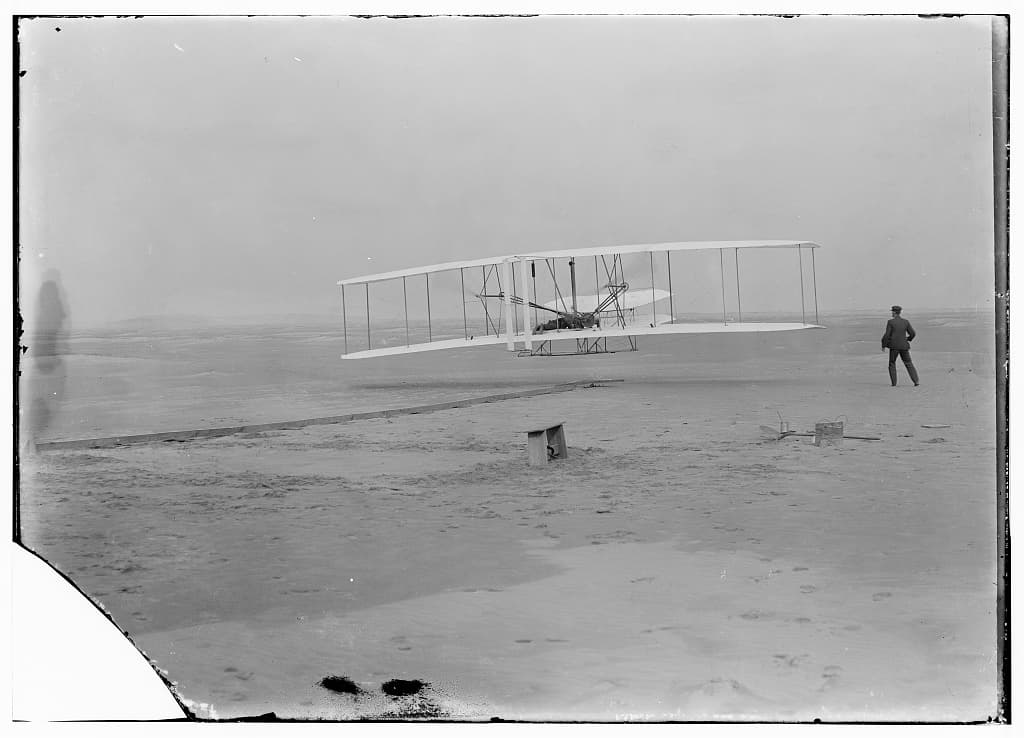
Orville takes off as Wilbur runs alongside at Kitty Hawk, 17 December 1903. Photograph by John T. Daniels. Library of Congress. What allowed them to see what established researchers missed? Was their advantage technical, organisational or psychological? Did being outsiders make it easier to question accepted knowledge? How much did their small team, short feedback loops and direct contact with every part of the machine matter? Where are today's equivalents of the Wright brothers working while attention and capital remain focused elsewhere?
Why have we normalised a system in which creators spend months making work, publish it for free and accept attention as payment, while platforms monetise the audience their work attracts?
The internet made publishing nearly free and gave creators access to audiences that were previously unreachable. In return, creators accepted a peculiar bargain: they supply the work, while social media platforms control its distribution and extract much of the economic value.
The largest digital platforms are built on work they did not create. Creators produce the writing, music, films, images and conversations that attract people, yet generally own no part of the network their work makes valuable.
The creator therefore bears the cost of making the work and receives likes and thumbs-up as payment. Even where revenue-sharing agreements exist, as with Spotify and YouTube, a creator may need an audience larger than most cities to earn the equivalent of the world's average monthly salary: $1,480 in purchasing-power-adjusted terms.
That is absurd.
These platforms provide real value through hosting, discovery and distribution. But the companies built around creators' work are worth trillions and make tens of billions of dollars in annual profit from the attention that work attracts.
Why did this become sufficient payment for creative labour? Why does the audience relationship belong primarily to the platform rather than the person whose work attracted it? What would an internet look like where creators owned their distribution, could move their audience between services and participated economically from the first person their work brought to a platform?
Why are people still in prison for selling cannabis while licensed companies legally profit from selling the same drug?
Cannabis is now legally sold by licensed businesses across much of the United States. Yet federal prosecutions continue. In the 2025 fiscal year, 389 people were sentenced for federal marijuana offences. Eighty-five per cent received prison sentences, with an average sentence of 44 months. United States Sentencing Commission
389people sentenced85%sentenced to prison44months on averageFederal marijuana offences, fiscal year 2025. This is not principally a question about simple possession. The Sentencing Commission found that, as of January 2022, nobody sentenced solely for federal simple possession remained in federal custody. The contradiction concerns people serving sentences for producing and distributing a substance that other people can now produce and distribute legally under a licence. United States Sentencing Commission
What moral distinction does a licence, state border or date in a statute create between these people? When society decides that an activity should be legal, why does that judgment not automatically trigger a review of sentences imposed under the previous law? Should legalisation without retrospective justice be considered incomplete?
Why did the public imagination for NFTs stop at speculative art when they could solve one of the internet's most fundamental problems: proving who owns something digital?
The world has spent decades turning physical things into digital ones.
In 1971, the United States stopped foreign governments from converting dollars into gold, helping bring the Bretton Woods system to an end. Today, most of the money you own is not cash in your hand. It is a number in a bank's database. Federal Reserve History
Music moved from records and CDs to digital files and streaming. Contracts moved from paper and handwritten signatures to PDFs and electronic signatures. Photographs, books, films and an increasing amount of art now exist primarily as digital files.
But digitisation created a problem we still have not properly solved: how do you prove that something digital belongs to you?
A digital file can be copied perfectly. If I send you a JPEG, we now both possess identical files. Nothing inside either file tells the rest of the world which one is the original, who created it, who owns it or how it changed hands.
So we depend on central authorities to maintain those records. A bank tells us how much money we own. A land registry records who owns a house. A platform decides who owns an account. A copyright office records a claim to a creative work.
NFTs offer another approach.
Put simply, an NFT is a public record connecting a unique digital token to an owner. That record can show who created the token, who currently holds it and every transaction through which it changed hands. Anybody can inspect the same history without asking a platform to reveal its private database.
It does not make the underlying JPEG impossible to copy. It makes ownership and provenance independently verifiable.
That distinction is more important than it first appears.
Even the use of NFTs in art is more interesting than the speculation surrounding it. Establishing the authenticity of a physical painting can require ownership records, expert judgment, material analysis and historical research. We may establish when a painting was produced, but proving exactly who made it and how it changed hands is not always foolproof.
An NFT created by a verified artist could establish an exact record from the moment it is issued. Every subsequent owner and transfer could then remain publicly visible.
But there is an important limitation. An NFT can prove the history of a token after it has been created. It cannot independently prove that the person who created it had the right to represent the artwork, house, licence or other asset in the first place. The connection between the record and the thing it represents must still be established. WIPO
That is a real problem. It is not a reason to dismiss the technology.
The internet gave us a way to publish and copy information globally. NFTs give us the beginnings of a way to establish ownership and provenance within that digital world. That could affect far more than profile pictures: creative work, licences, contracts, tickets, credentials and other rights that currently depend on separate institutions and private databases.
So why did the public conversation stop at speculative art and collapsing prices? Why did we treat a poor first application as proof that the underlying technology had no value? What becomes possible when a digital object can have an owner, a verifiable history and rights that move with it?
And what would need to be true before we could trust those records with the important things we increasingly create, exchange and own digitally?
Why is Africa described as dependent on aid when an estimated $203 billion leaves the continent through profit repatriation, debt payments, illegal resource extraction and other outflows each year, more than ten times the $19.7 billion it receives in aid?
A 2017 analysis estimated that African countries received approximately $19.7 billion in aid, while $203 billion left through multinational profit repatriation, debt payments, illegal resource extraction and other costs.
Aid received$19.7bnTotal outflows$203bnLatest available annual figures used in Honest Accounts 2017. Multinational companies took out an estimated $32.4 billion in profits. Illegal resource extraction, including fishing and wildlife trading, accounted for another $29 billion. And considerably more is lost through the wider illegal extraction of natural resources.
Across all measured inflows and outflows, the continent experienced a net annual loss of more than $40 billion. Honest Accounts 2017.
This reverses the familiar story. The central question may not be why wealthy countries give too little aid, but why the international financial and commercial system allows considerably more African wealth to leave in the first place.
Who is financing whom?
Why is aid publicly presented as generosity while profit extraction and natural-resource extraction are discussed separately? Would fair taxation, transparent ownership, stronger resource contracts and retaining more value locally matter more than additional aid?
If more capital leaves than arrives as aid, who is supporting whom? How much responsibility belongs to domestic governments, multinational companies, commodity traders and the financial centres where the money ultimately resides? Would preventing extraction, mispricing and capital flight do more than increasing aid? Why has the image of Africa as a passive recipient remained more powerful than the evidence of wealth continually leaving it?
Why is there no canon for learning how to run a life?
If you study economics, you quickly encounter The Wealth of Nations and Keynes's General Theory. If you study moral philosophy, you encounter Reasons and Persons and A Theory of Justice. Entire disciplines organise themselves around a small number of foundational books that serious students are expected to know.
But there is no equivalent canon for many of the decisions that determine the shape of a life.
How should you choose what to study? How should you select a career, choose a partner, maintain friendships or raise children well? How should you manage money, stay on top of bills, care for ageing parents, deal with grief or recognise when you are making the same mistake repeatedly?
There are thousands of books about each of these subjects, but few that are so definitive that two people trying to solve the same problem could be expected to have read them. Much of what people learn instead comes from their parents, friends, employers or expensive professional advice. This means access to practical knowledge often depends on where you start and who happens to be around you.
These are not minor skills. Research increasingly connects social and emotional abilities with employment, health, relationships, life satisfaction and participation in society. The OECD now argues that these skills should be developed throughout adulthood, not treated as incidental by-products of formal education. OECD
Is it impossible to write great, enduring books about how to run a life, or have they simply not been written yet? Which principles are universal enough to teach without pretending that everyone should live the same way? What would belong in such a canon, and why do we spend years preparing people for work while leaving them to improvise almost everything else?
What would we need to understand about a person before an AI agent could genuinely act like them?
Since the 1980s, the Big Five has become one of the most widely used ways of modelling personality. It describes people across five broad dimensions: openness, conscientiousness, extraversion, agreeableness and emotional stability. These traits can help predict patterns in work, health, relationships and decision-making, although their usefulness varies by context and culture. OECD, American Psychological Association
But broad personality traits are not enough to recreate a person.
An AI agent acting on my behalf would need to know more than whether I am conscientious or introverted. It would need to understand my taste, values, relationships, ambitions, risk tolerance and the principles I use when making difficult decisions. It would need to know when I follow a rule, when I make an exception and why I sometimes behave differently from the person I claim to be.
Recent research suggests that personality traits can be deliberately induced in language-model agents and can influence their decisions. But producing answers that resemble someone's personality test is not the same as representing that person faithfully. Designing LLM-Agents with Personalities
What evidence should such an agent learn from: questionnaires, messages, emails, previous decisions or years of observed behaviour? How should it distinguish temporary moods from enduring values? How should it change as the person changes? Could an agent sound exactly like you while consistently making decisions you would never make?
Before we can build a useful digital clone, we may need a much better model of what makes someone themselves.
Why does Japan make ordinary things so well?
What stands out about Japan is not only the quality of its most expensive products. It is the quality of ordinary things.
A convenience-store meal, public toilet, train station, cheap hotel, neighbourhood shop or piece of packaging often appears to have received more thought than its price or importance would seem to justify. The experience is not always luxurious. It is simply considered.
Wealth cannot fully explain this. Japan's income per person is substantially below that of the United States, yet it frequently delivers a higher baseline of care, reliability and finish in everyday life. Its economic growth and service-sector productivity have also faced serious problems. This is not a country where every system works perfectly. World Bank, OECD
Yet the areas that work often work extraordinarily well. JR Central reported an average delay of 0.9 minutes per train on the Tokaido Shinkansen, while Harvard's Growth Lab describes Japan as maintaining the world's highest economic complexity despite slow productivity growth. JR Central, Harvard Growth Lab
What produces this level of ordinary execution? Is it craftsmanship, competition, standardisation, social expectation, institutional memory or a lower tolerance for inconveniencing other people? Are train punctuality, careful packaging and well-maintained public spaces expressions of the same underlying quality, or are we grouping unrelated observations together?
Which things are genuinely better, and which only appear better to visitors? What are the costs of maintaining such standards? Most importantly, can another country deliberately develop this kind of execution capital, or does it emerge from habits and institutions that take generations to build?